
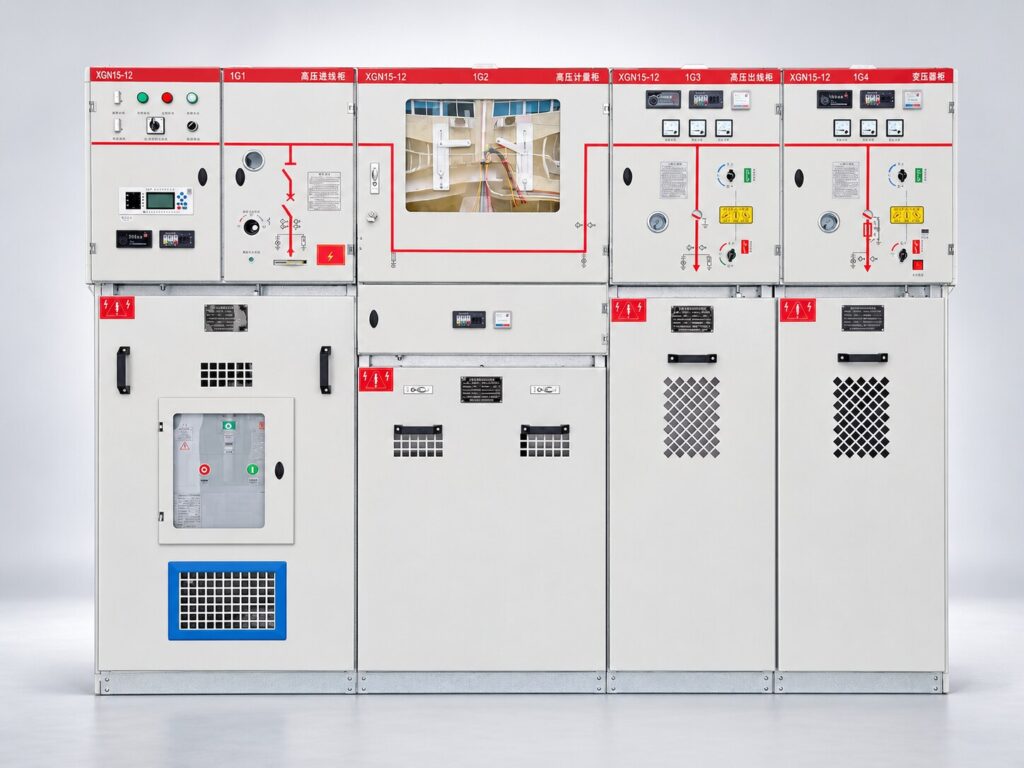
Direct answer: GIS encloses primary switching components in a sealed gas or solid-insulation system, while AIS relies mainly on air clearance. GIS is usually selected when space, environmental resistance and compact configuration matter; AIS is often preferred when accessibility, familiar maintenance and lower initial cost are the priority.
GIS vs AIS at a Glance
| Selection factor | GIS | AIS |
|---|---|---|
| Insulation | Sealed gas or solid-insulated primary circuit | Air-insulated primary circuit |
| Footprint | Compact | Generally larger |
| Environment | Well suited to dust, humidity and restricted rooms | Best where clean air clearances and maintenance access are available |
| Inspection | Primary components are enclosed | Primary components are more accessible |
| Configuration | Modular or compact functional units | Panel-based arrangements |
| Typical use | Urban distribution, renewable energy, mining, compact substations | Industrial plants, substations and projects with sufficient space |
What Is GIS?
Gas-insulated switchgear places the main circuit inside a controlled enclosure. This reduces dependence on external air clearance and helps provide a compact arrangement. Medium-voltage GIS may be designed for utility distribution, EPC substations, solar and BESS projects, industrial power systems, mining and infrastructure.
What Is AIS?
Air-insulated switchgear uses air as the main insulation medium between live parts. It normally requires more installation space but offers familiar visual access and flexible maintenance arrangements. AIS remains widely used where the electrical room, safety clearance and operating environment are suitable.
How to Select
- System voltage: confirm nominal and highest system voltage.
- Rated current: select according to feeder load and project expansion.
- Short-circuit duty: confirm short-time and peak withstand requirements.
- Room dimensions: compare equipment footprint, cable access and service aisle.
- Environment: review altitude, temperature, humidity, pollution and corrosion conditions.
- Functional units: define load-switch, circuit-breaker, fuse, metering and bus-section requirements.
- Documents: provide the SLD, specification, BOQ and preferred protection scheme.
Qiangchi Product Routes
For compact medium-voltage distribution, review the QCL-12 RMU, QCL-24 GIS and QCL-40.5 GIS. For air-insulated distribution, see XGN15 air-insulated RMU. Final configuration is confirmed from the project SLD and technical specification.
Engineering and FAT Support
Qiangchi can review the SLD, prepare a project-specific configuration, coordinate GA drawings and technical clarification, and confirm the inspection and FAT scope before shipment. Dimensions, protection devices, cable interfaces and optional accessories depend on the approved configuration.
Frequently Asked Questions
Is GIS always better than AIS?
No. The correct choice depends on space, environment, budget, maintenance strategy and system requirements.
Can GIS be used for outdoor projects?
Outdoor use depends on the enclosure and project design. Send the installation conditions for confirmation.
Which option is more compact?
GIS is generally more compact because the primary circuit is enclosed and requires less external air clearance.
What information is required for quotation?
Please send system voltage, rated current, short-circuit level, SLD, quantities, application and specification.
Can Qiangchi customize the functional units?
Project-specific configurations can be evaluated from the SLD and required C, V, F, PT, metering or bus-section functions.
Are dimensions fixed?
Dimensions depend on voltage class, functional units, cable arrangement and optional components. GA drawings are issued for the approved project configuration.
Need a GIS or AIS Selection Proposal?
Send your SLD or specification. Qiangchi will review the voltage, current, fault level, functional units and project conditions.